The Canine Stroke Foundation brings trusted veterinary knowledge to families who need it most. We provide open resources, clear information, and financial help for dogs and cats affected by stroke and cerebrovascular disease.
Inspired by Finley, who meets every milestone in physical therapy with the kind of joy that makes all of this worthwhile.
The Canine Stroke Foundation is the parent organization. The Finley Initiative and The Feline Stroke Initiative are its education and outreach programs. Each one does something different, but all three share the same mission and the same standards.
A nonprofit working toward 501(c)(3) status that will raise and give out funds for dogs affected by stroke and neurological conditions. Our focus is helping families afford care and staying accountable, so cost is never the reason a family loses hope.
Financial Assistance · Grants
An education and outreach program within the Foundation. It provides clear, well-researched resources for pet parents going through canine stroke recovery, bringing clinical knowledge home to the families who need it most.
Education · Resources · Outreach Learn more →
An education and outreach program focused on feline cerebrovascular disease. It operates under the same mission and standards as The Finley Initiative. Well-researched resources for families dealing with stroke and neurological conditions in cats.
Education · Resources · Outreach Learn more →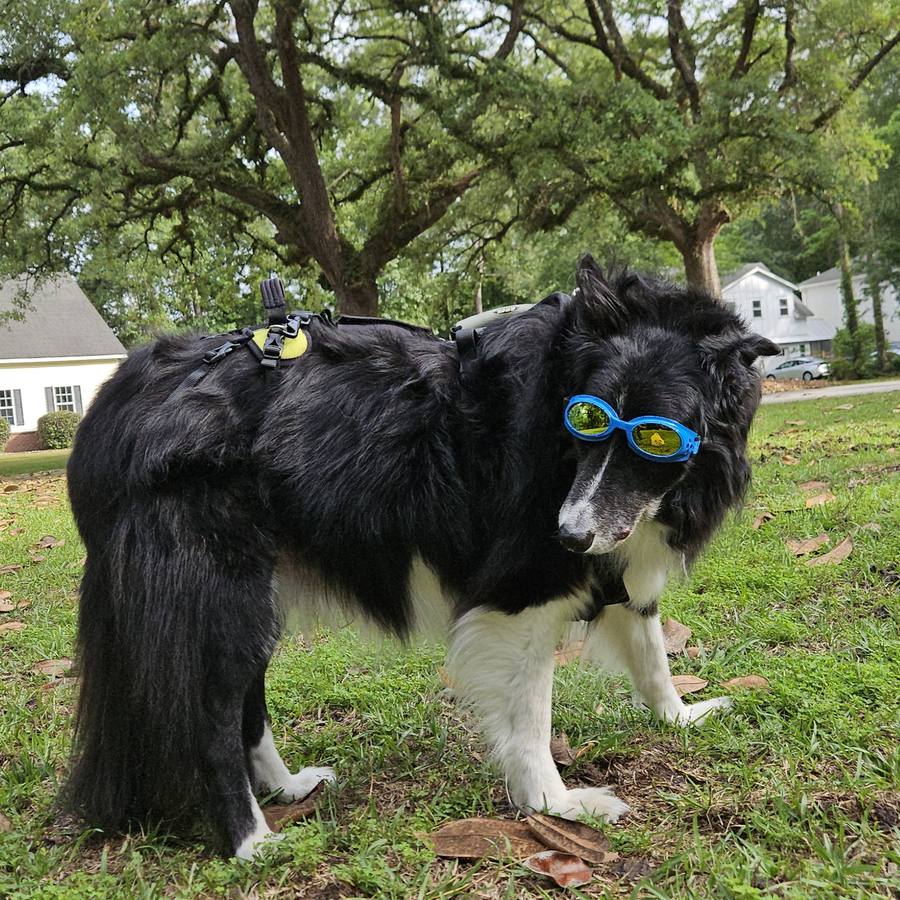
The heart of this Foundation, in the goggles that protect his eyes.
Finley is a Border Collie, born February 2, 2012. He was 13 when the first stroke hit in August 2025. Since then he has had four strokes, two close calls I caught in time, and several transient ischemic attacks (TIAs, also called mini-strokes). Nothing about his recovery has ever been certain.
Hypothyroidism is what put him at risk. An underactive thyroid can lead to high blood pressure, and to atherosclerosis, which is the narrowing and hardening of arteries. Both of those turn up again and again in dogs who have ischemic strokes. Finley has high blood pressure. Keeping it controlled is part of how we try to prevent the next one.
Every one of those strokes was diagnosed based on his symptoms by his two neurologists. We never got an MRI. It runs $4,000 to $6,000, and I couldn't afford it.
I spent many years as a veterinary technician, and I still couldn't find what we needed. No one told me anything. I looked up the research and the websites myself, one at a time, trying to work out what was happening to him and why. What was out there was scattered, inconsistent from one source to the next, and rarely written in a way an owner can actually use in the middle of a crisis.
If that was true for me, it was true for every family facing this without a clinical background. That's why caninestroke.org exists: to put it in one place. That gap, the isolation, and costs like the MRI we couldn't reach are what this Foundation is trying to close. Finley's story is not unusual. But it is the reason this work began, and his recovery is the reason it continues.
So this is his story in full: what I saw before each episode, the sign that kept repeating, and how he is really doing now.
This is what I noticed before each one. I'm recording it in this much detail because it's the record I wanted and couldn't find.
He skipped dinner the night before. The next morning his eyes were darting side to side and he could not stand. With assistance, he was walking in circles. A head tilt to one side followed.
It started with him being hesitant to walk, as if he could not see well. Then his eyes started darting side to side, and he lost control of all four legs. A head tilt to the side developed later. A few days later, he had four days of episodes that looked like seizures. Those were his TIAs, and when they started, his symptoms switched sides.
The same hesitant walk came first, like a vision problem. Then his right eye started darting up and down while his left eye stayed still and lost vision, and his left limbs stopped working. He already had a head tilt, but it became worse. He got some of that vision back within a couple of weeks, but never all of it.
He was hesitant to walk, acting very strange and confused, and refusing to potty even though he was outside and overdue. I recognized it early enough to step in. No stroke followed.
He was hesitant to walk, almost unwilling to move at all. His back right leg went stiff, and his back left leg gave out. He walked in circles.
This one happened at a vet visit for heart radiographs. After the X-rays, on the walk back to the car, the hesitancy to walk was there again. Then he got wobbly in his back end. I calmed him down, and no stroke occurred.
Every episode after the first one started the exact same way: a hesitancy to walk that looked like a vision problem, before anything else showed up. Three strokes and both close calls. Five of the six events above.
It was easy to miss and easy to explain away. It's the earliest thing I have to go on, and it's the one I watch for now, because in both close calls I recognized the signs early enough to step in, and no stroke happened.
Stroke can leave dogs with vision loss, ranging from partial impairment to total blindness. That means they don't always see what's right in front of them, and it can lead to real eye injuries. Finley would push his face into bushes and scratch his eyes without knowing the branches were there. The goggles act like a shield. They protect his eyes as he moves through the world during recovery.
Vision runs through his whole timeline. Every episode after the first opened with a hesitant walk that looked like he could not see well. In January his left eye lost vision outright. He got some of it back within a couple of weeks, though never all of it, and the summer episodes took more still. The goggles are there because of what the strokes took.
People ask me often how Finley is really doing. "Is he in pain?" "Are you sure his quality of life is okay?" I hear some version of these questions all the time, usually from someone who has just watched him walk.
His strokes left him with a cerebellar gait: swaying, wobbly, sometimes stumbling. To a lot of people, he looks like he's dealing with bad arthritis pain. It's understandable that it looks terrible if you don't know what's causing it.
That's part of why I lean on real standards for measuring quality of life, not just how a walk looks from the outside. Structured quality of life assessments look at the whole dog:
Finley is happier now than he has ever been. His strokes took away the fear and anxiety he used to carry every day. The dog in front of me now is calmer, more content, and more himself than he was before any of this happened.
Whether he is eating well, staying engaged, wanting affection, sleeping normally, and feeling calm instead of afraid: those are the things that actually tell me how he is doing. He is recovering with physical therapy, laser therapy, acupuncture, electroacupuncture, and PEMF therapy. He takes medication for pain, blood pressure, platelets, and thyroid, plus liver support for a benign mass in his liver. Finley gets lots of love. He's doing great.
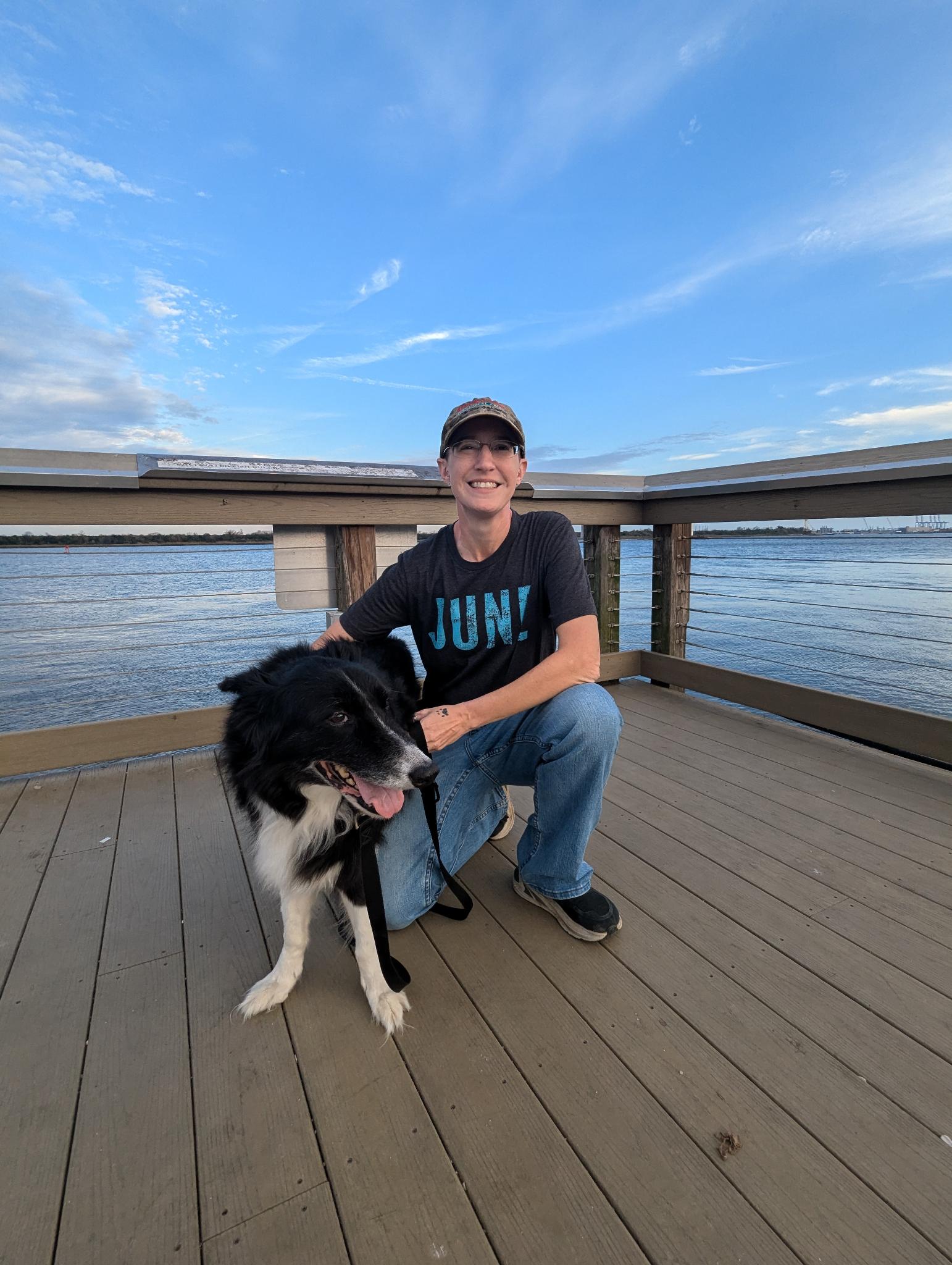
My veterinary training was on the job rather than in a classroom, and that distinction has mattered more than I expected.
My training truly began at All Pets Veterinary Center in Louisville, Kentucky, under Dr. Missy Jewell, MS, DVM. Over the years that followed, I worked across multiple clinics in different cities, adapting to new teams, new practice cultures, and a wide range of patients. That breadth gave me something a single long-tenure position rarely does: a clear, comparative picture of where veterinary care succeeds and where it falls short.
Before clinical practice, I worked as a zookeeper in the United States, caring primarily for kangaroos and other Australian wildlife. It taught me to observe carefully, act with limited information, and hold a high standard of care for animals that couldn't tell me what was wrong.
In 2019, I transitioned out of clinical practice and into full-time professional pet sitting. Running my own business has meant being solely accountable to my clients and their animals, with no institution to defer to and no safety net.
My degree is a Bachelor of Interdisciplinary Studies from Western Kentucky University, built around a strong focus in biology and chemistry. I'm currently enrolled in a graduate certificate in Veterinary Science through the University of Illinois College of Veterinary Medicine, and I plan to continue into the master's program.
Earlier this year, I founded the Canine Stroke Foundation, a nonprofit working toward 501(c)(3) status, focused on canine and feline stroke awareness, pet parent education, and financial assistance for families facing treatment costs. The Finley Initiative and the Feline Stroke Initiative operate as its dedicated education programs. The organization also seeks to advance canine and feline stroke research in a space that has historically received very little of it.
I'm building it the way I would have wanted it handed to me. The dogs who come after Finley should have an easier time of it than he did.
These are not values we are working toward. They are commitments already embedded in how this organization is structured and governed.
All resources reflect current veterinary knowledge. We do not publish speculation, trends, or claims not supported by accepted practice. As medicine evolves, so do we.
Every dollar is treated as entrusted, not owned. Funds are distributed on medical need and financial hardship, not social reach or personal connection.
We do not raise funds through distortion, fear, or exaggerated claims. We share real stories accurately because trust is the only currency that lasts.
Required by bylaws. No director, officer, or advisor may benefit personally from funds. Conflicts are disclosed and recused, without exception.
Whether you're a veterinary professional, a pet parent who has gone through this, or someone who wants to support this work, there's a place for you here.
Volunteer With Us →General inquiries
info@caninestroke.org