
The Feline Stroke Initiative

An education and outreach program focused on stroke and embolism (blood clots) in cats. It operates under the same mission and standards as The Finley Initiative. Well-researched resources for families dealing with these conditions.
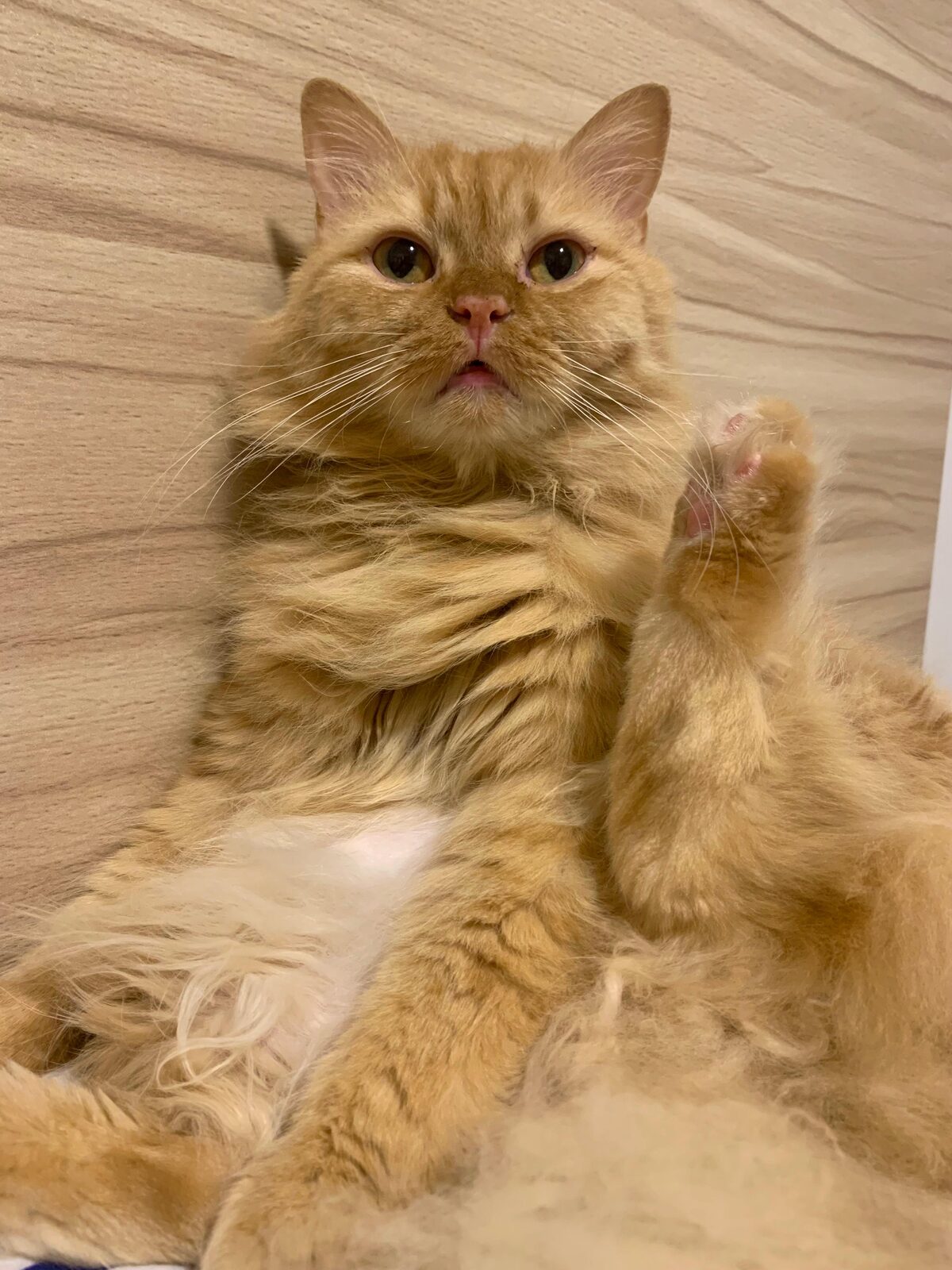
Batata, also known as Sweet Potato, the cat behind the Feline Stroke Initiative.

If you think your cat is having a stroke or a blood clot, get to a veterinarian now. Sudden weakness or paralysis in one or more legs, crying out in pain, difficulty breathing, a head tilt, or collapse are all emergencies. Do not wait to see if it passes. Call your regular veterinarian or the nearest emergency clinic.

Recognizing the Signs

Catching it early saves lives

The cats who have strokes are not random. They tend to share a pattern. Knowing that pattern is the fastest way to catch a problem before it turns into a crisis.

Call your vet the same day if you see any of these

  • A sudden head tilt, or walking in circles1
  • Loss of balance, or a wobbly, clumsy walk21
  • Weakness or paralysis, often on just one side13
  • Odd eye movements, or sudden loss of vision124
  • A seizure21
  • Acting confused, or being very sleepy and hard to wake21
  • Signs that come on suddenly, not slowly over weeks3
  1. Moretto L, Beckmann K, Günther C, et al. Manifestations of hypertensive encephalopathy in cats. Journal of Feline Medicine and Surgery. 2023;25(2). doi.org/10.1177/1098612X231153357 free full text
  2. Brown CA, Munday JS, Mathur S, et al. Hypertensive encephalopathy in cats with reduced renal function. Veterinary Pathology. 2005;42(5):642-649. doi.org/10.1354/vp.42-5-642
  3. Altay UM, Skerritt GC, Hilbe M, et al. Feline cerebrovascular disease: clinical and histopathologic findings in 16 cats. Journal of the American Animal Hospital Association. 2011;47(2):89-97. doi.org/10.5326/JAAHA-MS-5480
  4. Maggio F, DeFrancesco TC, Atkins CE, et al. Ocular lesions associated with systemic hypertension in cats: 69 cases (1985-1998). Journal of the American Veterinary Medical Association. 2000;217(5):695-702. doi.org/10.2460/javma.2000.217.695

Blood clots are a different emergency, with their own signs

A clot that breaks loose and lodges in an artery is called arterial thromboembolism. It comes on within minutes, and it is one of the most painful things that can happen to a cat. Most often it blocks the artery to both back legs, but a front leg can be affected too.1 Call an emergency vet right away if you see:

  • Sudden dragging, weakness, or no use at all of one or more legs, most often the back legs2
  • Crying out or obvious pain, especially around the affected leg or legs1
  • Legs or paws that feel cool or cold to the touch1
  • Pale or bluish paw pads and nail beds1
  • No pulse you or your vet can feel in the affected legs1
  • Fast or hard breathing, even in a cat who is not in heart failure12
  • A cat who feels cold all over. A low body temperature is linked to worse outcomes.12

Together these add up to a picture vets recognize: no pulses, pale tissue, legs that will not work, and cold limbs in a cat that is clearly in pain.1

  1. Borgeat K, Wright J, Garrod O, et al. Arterial thromboembolism in 250 cats in general practice: 2004-2012. Journal of Veterinary Internal Medicine. 2014;28(1):102-108. doi.org/10.1111/jvim.12249 free full text
  2. Smith SA, Tobias AH, Jacob KA, et al. Arterial thromboembolism in cats: acute crisis in 127 cases (1992-2001) and long-term management with low-dose aspirin in 24 cases. Journal of Veterinary Internal Medicine. 2003;17(1):73-83. doi.org/10.1111/j.1939-1676.2003.tb01326.x

That last point matters most. Sudden is the word to watch for. A problem that builds slowly over months is usually something else. One sign carries extra weight: how awake and aware a cat is. That tells a vet more about how serious a brain injury is than almost anything else, so vets grade it on a set scale, the modified Glasgow Coma Scale, instead of guessing.1

  1. Platt SR. Altered states of consciousness in small animals. Veterinary Clinics of North America: Small Animal Practice. 2014;44(6):1039-1058. doi.org/10.1016/j.cvsm.2014.07.012

If your cat shows any of these signs, don't wait it out. Get to a vet.

Which cats are most at risk

  • Senior cats. Risk adds up with age, mostly because the illnesses below are common in older cats.1
  • High blood pressure. This is one of the strongest causes, especially in cats with kidney disease that is not being treated well or has not been found yet. Blood pressure that stays high wears down the small blood vessels in the brain. Some of those vessels get too narrow, and the tissue behind them starves. Your vet may call that an ischemic stroke. Others get weak and burst, which is a hemorrhagic stroke.2 In cats with high blood pressure, an estimated 29 to 46% show signs that their brain is affected.345
  • An overactive thyroid. This often causes the high blood pressure. And treating the thyroid does not reliably fix the blood pressure, even with radioiodine treatment.6
  • Heart disease, especially the thickened-heart kind called HCM. When the upper left chamber of the heart gets stretched, blood slows and pools there, and that is where clots form. A stretched left atrium is one of the main warning signs vets use to judge a cat’s clot risk.7 Blood in these cats also tends to clot more easily than normal, often well before any clot forms.8
  • Diabetes, and blood that is too thick, either from too many red cells (polycythemia) or too much protein in the blood (paraproteinemia). Both of these make a clot more likely.

What catching it early actually looks like

  1. Blood pressure. Have it checked regularly once your cat is a senior, and more often if your cat has kidney disease, an overactive thyroid, or diabetes. Vets grade it on a standard scale from the American College of Veterinary Internal Medicine: under 140 mmHg is normal, 140 to 159 is borderline, 160 to 179 is high, and 180 or above is severe.12
  2. Bloodwork. A senior panel that checks thyroid and kidney values, since both conditions drive the blood pressure problem above.3
  3. The heart. Ask your vet to listen for a murmur or an uneven rhythm, and whether your cat should have a heart scan. Heart disease is a leading reason cats throw clots, and it is often silent until one does.4
  4. If bleeding in the brain is possible, ask for a liver panel too, not just the usual platelet and clotting tests.5
  5. Push for a scan when signs come on suddenly. An MRI is still the only reliable way to tell a stroke apart from a tumor, brain inflammation, or another cause.
  6. Ask for a specialist referral. A veterinary neurologist if a stroke is suspected, or a veterinary cardiologist if a clot is suspected. In cats, clots almost always come from a heart that was already diseased. In a study of 127 cats with a clot, nearly all had an enlarged left atrium, and most had a cardiomyopathy.64 Finding and treating that heart problem is what lowers the odds of another one.

This is the work the Feline Stroke Initiative exists to support: helping families and vets catch these cats before a crisis, not just treat them after one.

  1. Taylor SS, Sparkes AH, Briscoe K, et al. ISFM consensus guidelines on the diagnosis and management of hypertension in cats. Journal of Feline Medicine and Surgery. 2017;19(3):288-303. doi.org/10.1177/1098612X17693500 free full text
  2. Brown CA, Munday JS, Mathur S, et al. Hypertensive encephalopathy in cats with reduced renal function. Veterinary Pathology. 2005;42(5):642-649. doi.org/10.1354/vp.42-5-642
  3. American Association of Feline Practitioners. Hypertension Educational Toolkit: Clinical Signs. Accessed August 26, 2026. catvets.com/resource/hypertension-toolkit-clinical-signs
  4. Maggio F, DeFrancesco TC, Atkins CE, et al. Ocular lesions associated with systemic hypertension in cats: 69 cases (1985-1998). Journal of the American Veterinary Medical Association. 2000;217(5):695-702. doi.org/10.2460/javma.2000.217.695
  5. Moretto L, Beckmann K, Günther C, et al. Manifestations of hypertensive encephalopathy in cats. Journal of Feline Medicine and Surgery. 2023;25(2). doi.org/10.1177/1098612X231153357 free full text
  6. Stammeleer L, Xifra P, Serrano SI, et al. Blood pressure in hyperthyroid cats before and after radioiodine treatment. Journal of Veterinary Internal Medicine. 2024;38(3):1359-1369. doi.org/10.1111/jvim.17032 free full text
  7. Luis Fuentes V, Abbott J, Chetboul V, et al. ACVIM consensus statement guidelines for the classification, diagnosis, and management of cardiomyopathies in cats. Journal of Veterinary Internal Medicine. 2020;34(3):1062-1077. doi.org/10.1111/jvim.15745 free full text
  8. Stokol T, Brooks M, Rush JE, et al. Hypercoagulability in cats with cardiomyopathy. Journal of Veterinary Internal Medicine. 2008;22(3):546-552. doi.org/10.1111/j.1939-1676.2008.0098.x
  1. Acierno MJ, Brown S, Coleman AE, et al. ACVIM consensus statement: guidelines for the identification, evaluation, and management of systemic hypertension in dogs and cats. Journal of Veterinary Internal Medicine. 2018;32(6):1803-1822. doi.org/10.1111/jvim.15331 free full text
  2. American Association of Feline Practitioners. Hypertension Educational Toolkit: Clinical Signs. Accessed August 26, 2026. catvets.com/resource/hypertension-toolkit-clinical-signs
  3. Taylor SS, Sparkes AH, Briscoe K, et al. ISFM consensus guidelines on the diagnosis and management of hypertension in cats. Journal of Feline Medicine and Surgery. 2017;19(3):288-303. doi.org/10.1177/1098612X17693500 free full text
  4. Luis Fuentes V, Abbott J, Chetboul V, et al. ACVIM consensus statement guidelines for the classification, diagnosis, and management of cardiomyopathies in cats. Journal of Veterinary Internal Medicine. 2020;34(3):1062-1077. doi.org/10.1111/jvim.15745 free full text
  5. Altay UM, Skerritt GC, Hilbe M, et al. Feline cerebrovascular disease: clinical and histopathologic findings in 16 cats. Journal of the American Animal Hospital Association. 2011;47(2):89-97. doi.org/10.5326/JAAHA-MS-5480
  6. Smith SA, Tobias AH, Jacob KA, et al. Arterial thromboembolism in cats: acute crisis in 127 cases (1992-2001) and long-term management with low-dose aspirin in 24 cases. Journal of Veterinary Internal Medicine. 2003;17(1):73-83. doi.org/10.1111/j.1939-1676.2003.tb01326.x

A brain tumor can look exactly like a stroke

The most common brain tumor that starts in a cat's brain is called a meningioma. Cats with a brain tumor are usually older, around 11 years old, which is the same age range where strokes happen.12 These tumors normally grow slowly. But if one bleeds, or if the tissue around it swells, a cat who seemed fine a few days ago can go downhill fast. On the day it happens, a tumor and a stroke can look identical. That is why a scan matters. You cannot tell them apart by watching the cat.

  1. Troxel MT, Vite CH, Van Winkle TJ, et al. Feline intracranial neoplasia: retrospective review of 160 cases (1985-2001). Journal of Veterinary Internal Medicine. 2003;17(6):850-859. doi.org/10.1111/j.1939-1676.2003.tb02525.x
  2. Veterinary Society of Surgical Oncology. Brain tumors: feline. Accessed August 26, 2026. vsso.org/brain-tumors-feline
Have a Question?

Is there a topic we should cover?

This page is just getting started. If there's something you wish you'd known about feline stroke or embolism, let us know and we'll work on covering it.

General inquiries

info@caninestroke.org
On the Way

Coming soon

We're building out cat-specific resources to match what's already on our Pet Parent Resources page. Here's what's coming:

Emergency Stroke & Embolism Guide Understanding Feline Stroke Understanding Feline Embolism Working With Your Vet Home Care & Recovery Informational Handouts Neurology Locator Rehab Locator Emergency Vet Locator Plain-Language Research Glossary Recovery & Rehab Guides Equipment & Product Guides Financial Assistance Educational Webinars Grief Support FAQ